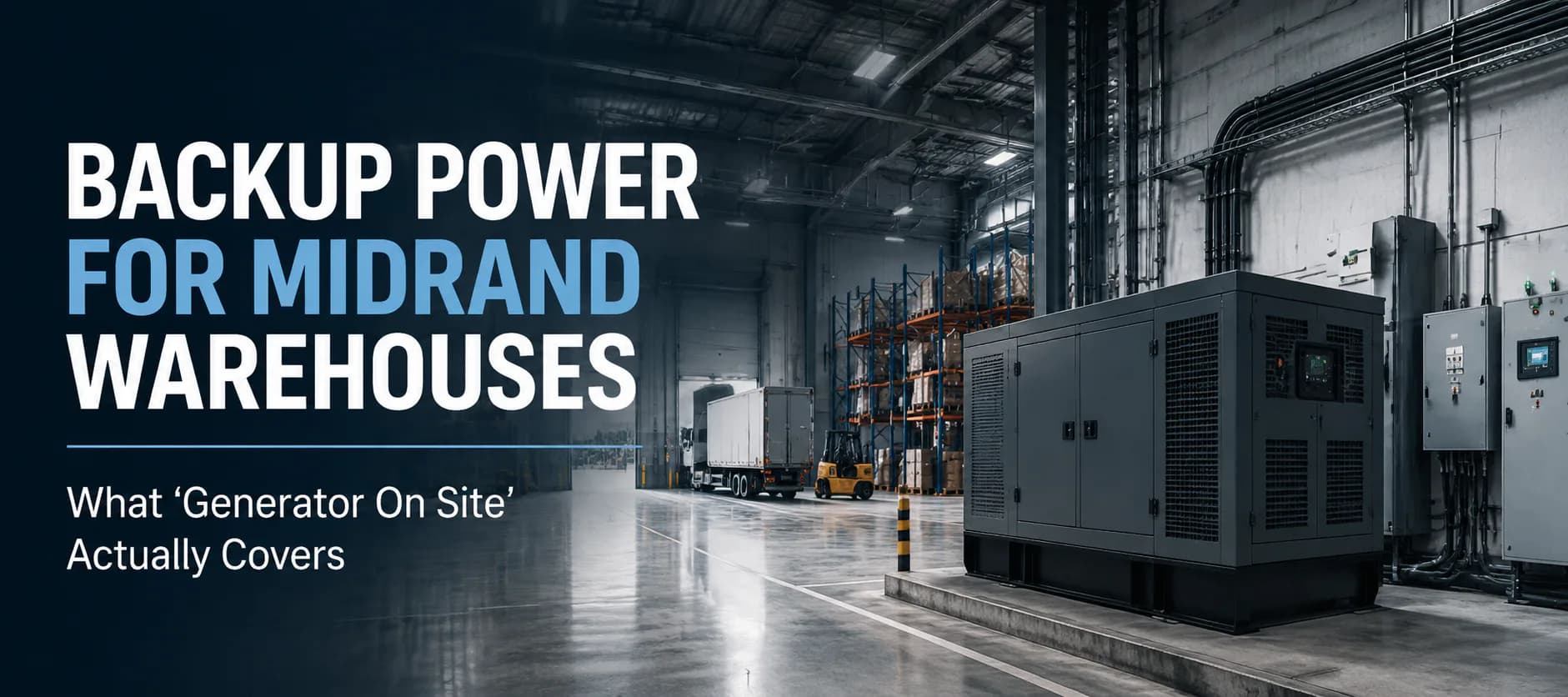
Backup Power for Midrand Warehouses: What "Generator On Site" Actually Covers
Why "there's a generator" is not a complete answer
Backup power is one of the most common questions Midrand warehouse tenants ask, and one of the most frequently oversimplified answers they get. A generator visible on site tells you very little on its own. What matters is which loads it covers, how quickly it takes over, and whether its capacity was sized for your equipment or for someone else's.
Before treating backup power as confirmed, tenants should ask for the generator's rated capacity, which circuits it services, and how that compares with a documented list of the equipment the business actually needs to keep running.
Start with a critical load list, not a generator spec sheet
The right starting point is not the generator, it is the business. List every system that must continue operating during a power interruption: security and access control, networks and servers, selected lighting, refrigeration, conveyors, charging stations for handling equipment, and any production or processing machinery.
Separate that list into what must never lose power, what can tolerate a short changeover delay, and what can simply wait until utility power returns. This priority list is what a landlord or electrical consultant needs to confirm whether a specific building's backup system can actually support the operation, rather than just "having power" in a general sense.
Capacity, changeover and the details that get missed
Three details separate a generator that helps from a generator that disappoints when it matters. Capacity is the rated load the generator can sustain, including the higher starting current that motors and compressors draw when they switch on, not just their running load. Changeover time is how long the gap is between utility power failing and generator power reaching your circuits, which matters enormously for equipment that cannot tolerate even a short interruption.
Fuel management is the third detail: how much runway the generator has at full load, how refuelling is arranged during an extended outage, and who is responsible for testing and maintaining the system. A generator that has not been load-tested recently is a risk, not a guarantee.
Connectivity is part of continuity too
Power is only half of business continuity. Warehouse management systems, barcode scanning, dispatch documentation, security cameras and customer-facing platforms usually depend on stable connectivity as much as electricity. Ask which internet service providers serve the building, where the entry points are, and whether redundant links are possible if the operation depends on being online.
Mobile signal coverage should also be checked directly inside the warehouse floor and yard, not assumed from the office area, since steel structures and racking can affect reception in parts of a large building.
What to ask before signing
A short, direct set of questions during the leasing process avoids assumptions later. What is the generator's rated capacity, and which circuits does it service? What is the measured changeover time? Who is responsible for fuel, maintenance and testing, and how often does that happen? Is backup capacity shared across multiple tenants in the building, and if so, how is it allocated during an outage?
Tenants with critical processes, refrigeration or continuous production should request written confirmation of backup capacity rather than relying on a verbal assurance during a site visit.
Building this into your continuity plan
Property specifications are one part of business continuity, not the whole plan. Document manual workarounds for each critical process, identify the maximum interruption each one can tolerate, and review this alongside the building's actual backup capacity rather than assuming the property alone removes every risk.
Frequently asked questions
Does a generator on site mean my whole warehouse will have power during an outage?
Not necessarily. Capacity is often allocated to specific circuits or critical systems rather than the entire building, so confirm which loads are covered before assuming full continuity.
How do I know if a generator's capacity is enough for my equipment?
Build a documented list of your equipment's rated load and starting current, then ask the landlord or an electrical consultant to confirm this against the generator's specification and any other loads it already supports.
Who is responsible for maintaining backup power systems in a leased warehouse?
This varies by lease and building. Confirm in writing whether the landlord or tenant is responsible for testing, servicing and fuel management, and how often the system is tested.