Commercial Storage vs Warehouse Space in Midrand: Which Do You Actually Need?
Two different problems, two different property types
Businesses searching for space in Midrand often use "storage" and "warehouse" interchangeably, but the two solve different operational problems. Getting this distinction right before contacting a landlord or broker saves time and avoids leasing more, or less, than the operation actually needs.
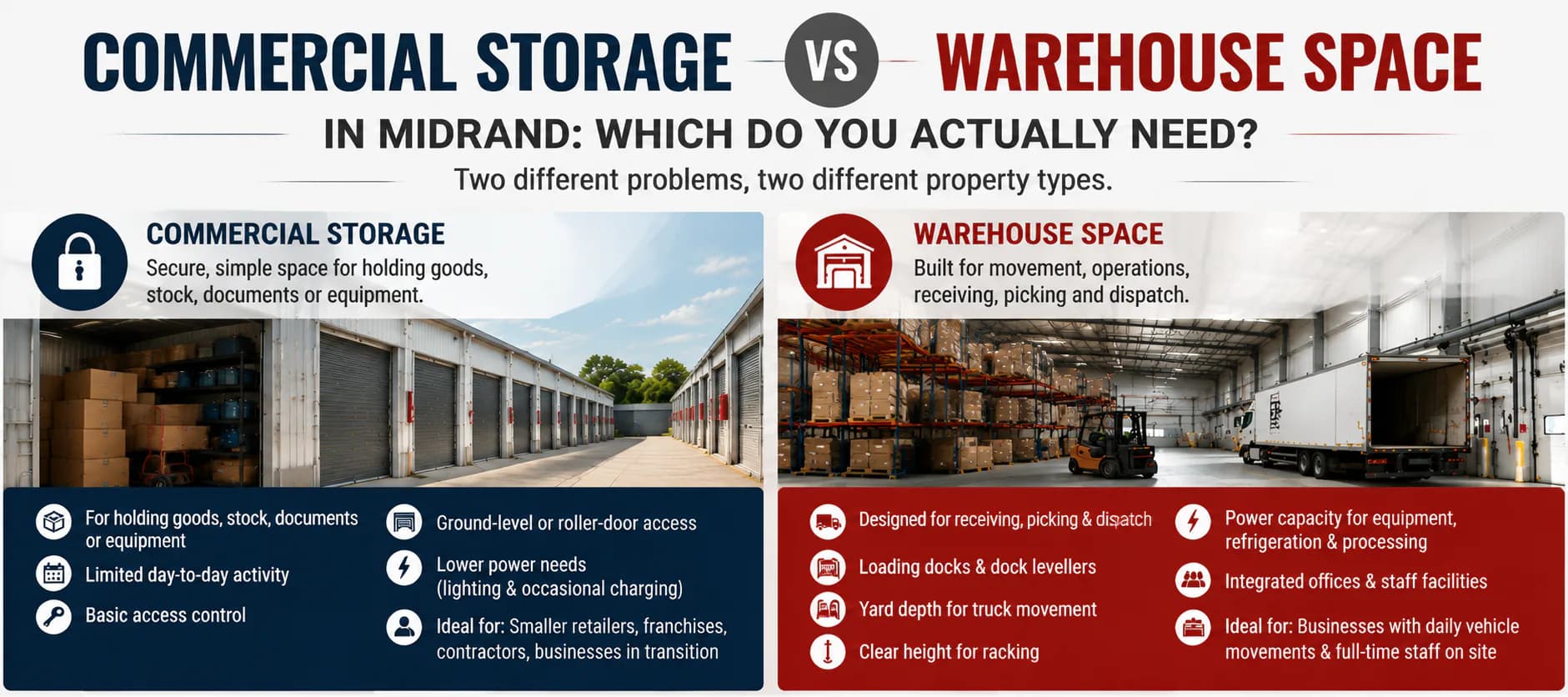
Commercial storage is typically about holding goods, stock, documents or equipment with limited day-to-day activity inside the space. Warehouse space is built around movement: receiving, picking, dispatch, staff working full shifts, and vehicles arriving throughout the day.
What commercial storage space usually means
Commercial storage in Midrand tends to suit businesses that need secure, lockable space for stock, records, seasonal equipment or overflow inventory, without needing a full operational footprint. Typical users include smaller retailers, franchises, contractors and businesses between office moves.
The practical requirements are usually narrower than a warehouse: basic access control, manageable unit sizes, and straightforward ground-level or roller-door access. Power needs are often limited to lighting and occasional charging rather than continuous equipment use.
What warehouse space is built for
Warehouse space at Midpoint and similar Midrand estates is designed around continuous operational flow. That means loading doors and dock levellers sized for regular vehicle traffic, adequate yard depth for turning and queuing, clear height suited to racking, and power capacity for handling equipment, refrigeration or light processing.
Warehouse tenants also usually need integrated office space for supervisors, dispatch administration and customer service, plus staff facilities for people working full shifts on site. Our full guide on warehouse space in Midrand covers what to check before shortlisting a building.
Questions that reveal which one you need
A few honest questions usually settle the decision. How often will someone physically enter the space each day? Storage users might visit a handful of times a week; warehouse operations run daily, often with multiple shifts. How many vehicles need to load or offload, and how large are they? Does the business need staff based on site permanently, or just periodic access? Is stock picked and dispatched to customers, or simply held until needed?
If the honest answers point to daily vehicle movements, staff working full-time on site, and active stock handling, a warehouse is the right category to search in, not a storage unit. If the need is closer to secure holding with occasional access, a smaller storage-type space, where available, is more cost-effective than leasing full warehouse specification you will not use.
Cost implications of choosing the wrong category
Warehouse space is priced for its loading infrastructure, power capacity and integrated offices, so leasing a full warehouse for pure storage usually means paying for yard space, door infrastructure and office allocation that never gets used. Conversely, trying to run active receiving and dispatch out of space that was never designed for vehicle circulation creates its own cost: congestion, safety risk, and an inability to scale.
Getting the brief right before you enquire
Before contacting a leasing team, write down realistic figures rather than impressions: expected vehicle visits per day, staff numbers on site, whether goods are picked and dispatched or simply stored, and any power-hungry equipment. That brief makes it much faster for a leasing team to point you toward the right category of space, rather than the closest available option.
Frequently asked questions
Does Midpoint offer commercial storage units, or only full warehouse space?
Midpoint's published availability is warehouse and industrial space rather than small self-storage units. Businesses with genuine storage-only needs should confirm current availability with the leasing team, since suitability depends on the specific size and access required.
Is warehouse space always more expensive than storage space?
Not necessarily per square metre, but a warehouse lease typically includes loading infrastructure, yard access and integrated offices that a pure storage unit does not, so the total cost reflects a different specification, not just a bigger box.
Can a business start with storage and move to a full warehouse later?
Yes, and it is a common growth path. Businesses should factor this into their lease term decisions and discuss growth plans with the leasing team from the outset rather than assuming a short lease will always be renewable in the same location.